
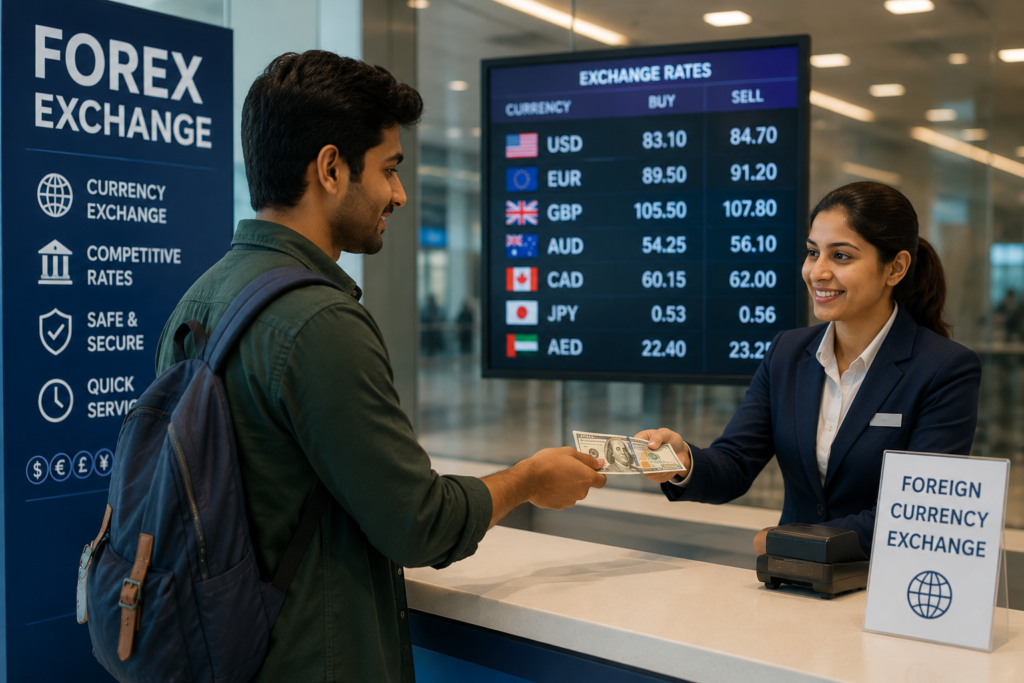
Forex exchange Hyderabad travelers use ranges from airport counters to bank branches to dedicated forex agents — and the rates and fees between these options can vary far more than most people realize. A poor exchange choice can quietly cost you thousands of rupees on a single trip. At Goyad Travel, forex is one of our core services, arranged directly alongside your flight and visa bookings so there’s one less thing to manage separately.
Why Forex Exchange Hyderabad Choices Matter
1. Airport Counters Are Almost Always the Worst Rate
It’s tempting to just exchange money at the airport right before your flight, but airport counters consistently offer the weakest exchange rates and highest hidden markups of any option — often 5-8% worse than what you’d get elsewhere. Treat it strictly as a last-resort, small-amount option, not your main plan.
2. Compare Cash vs Forex Card vs Debit/Credit Card Withdrawal
Each option has different costs. Carrying cash avoids ATM withdrawal fees abroad but carries loss/theft risk. A prepaid forex card locks in a rate before you travel and is safer to carry, though some cards charge reload or inactivity fees. Using your regular debit or credit card abroad usually incurs both a currency conversion markup and a foreign transaction fee — often the most expensive option per transaction if used repeatedly.
3. Lock Rates Early for Better Planning
Forex rates fluctuate daily. If you’re traveling during a period of currency volatility, locking in a portion of your forex needs early — rather than waiting until the week of travel — can protect you from unfavorable rate swings, especially for larger amounts needed for tuition or long trips.
4. Understand RBI’s Liberalised Remittance Scheme (LRS) Limits
Under India’s LRS, resident individuals can remit up to USD 250,000 per financial year for permitted purposes including education and travel. For students studying abroad, this limit matters for tuition and living expense transfers — worth understanding early if you’re funding a full academic year at once versus semester by semester.
5. Check TCS (Tax Collected at Source) Implications
Foreign remittances above certain thresholds attract TCS, with different rates depending on the purpose (education loan-funded remittances are typically taxed at a lower rate than other travel or personal remittances). This can meaningfully affect your total cost, especially for larger education-related transfers, so it’s worth factoring into your budget rather than discovering it at the time of transfer.
6. Carry a Mix, Not All Cash or All Card
A practical approach many travelers use: carry a modest amount of local currency cash for immediate needs (transport, small purchases) plus a forex card or two loaded with your main travel budget, and keep one card as backup in case the other is lost, blocked, or has technical issues abroad.
7. Buy From a Licensed, RBI-Authorized Dealer
Not every currency exchange counter is equally legitimate or competitively priced. Working with an RBI-authorized dealer ensures you’re getting properly regulated rates and documentation — important both for legal compliance and for LRS-related paperwork if you’re transferring larger amounts.
Forex for Students vs Tourists vs Business Travelers
Students heading abroad typically need the largest forex amounts — covering tuition remittances, initial living expenses, and often a blocked account deposit for countries like Germany. Planning this alongside your visa timeline, not as an afterthought once the visa is approved, avoids last-minute rate risk on a large amount.
Tourists usually need a smaller, more flexible mix — enough cash for the first day or two, plus a forex card for the bulk of trip spending, sized to the specific countries you’re visiting since exchange availability and rates vary by destination currency.
Business travelers often need quick turnaround and predictable costs — a forex card pre-loaded before a trip avoids the uncertainty of daily rate changes affecting a tightly budgeted expense report.
Common Forex Mistakes to Avoid
- Waiting until the day of travel to exchange currency, missing better rates available earlier
- Not comparing rates across at least two or three sources before a large exchange
- Ignoring TCS implications on large remittances and being surprised by the final cost
- Carrying 100% cash with no backup card, risking total loss if cash is lost or stolen
- Not checking whether your destination currency is easily available — some currencies need to be pre-ordered a few days in advance
Frequently Asked Questions
Is forex exchange Hyderabad service available same-day, or does it need advance notice?
Common currencies (USD, GBP, EUR, AUD, CAD) are usually available same-day or next-day; less common currencies may need 2-3 days’ advance notice.
Do I need forex exchange Hyderabad services if I’m just using a credit card abroad?
It’s still worth having some local cash and a forex card as backup — relying solely on card payments can be a problem in places with limited card acceptance or during network outages. Forex Exchange Hyderabad
Can Goyad Travel help with education-related forex remittances?
Yes — we handle forex alongside visa and study abroad services, so tuition and living-expense transfers are planned as part of your overall timeline, not separately. Forex Exchange Hyderabad
How Goyad Travel Helps
We treat forex as part of the full trip or study abroad picture rather than a standalone transaction — timed against your visa and travel dates so you’re not scrambling for a good rate at the last minute. This sits alongside our study abroad consultancy and travel insurance guide for anyone planning a full international trip. Forex Exchange Hyderabad
Need forex for an upcoming trip? Talk to us on WhatsApp or call +91 7997226661 / +91 7997226662.
📍 Goyad Travel — Road No. 11, Reliance Humsafar Building, Banjara Hills, Hyderabad, Telangana | View on Google Maps
📧 contact@goyadtravel.com | 🕐 Monday–Saturday, 9:00 AM – 7:00 PM