
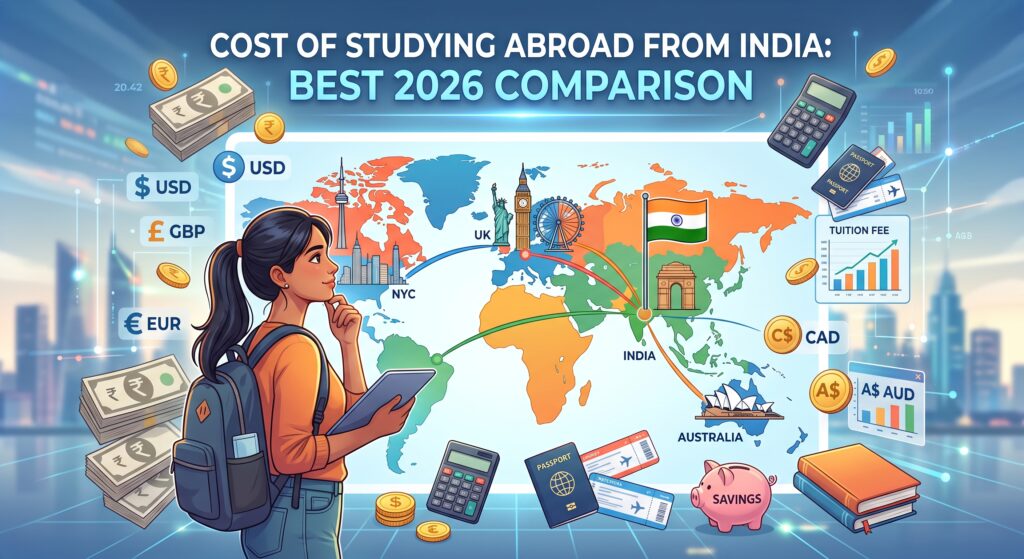
The cost of studying abroad from India varies dramatically depending on the country — a decision that’s less about which country is “best” and more about which one fits your actual budget once tuition, living costs, and hidden expenses are all accounted for. This is usually the single biggest factor that ends up narrowing down a family’s shortlist, often more than university rankings. Here’s a realistic, country-by-country breakdown.
Why Cost Comparison Matters More Than Rankings
Students and parents often start by comparing university rankings, but the cost of studying abroad from India frequently ends up being the deciding factor once real numbers are on the table. A mid-ranked university in an affordable country can be a smarter financial decision than a slightly higher-ranked one in an expensive city — especially once you factor in the full duration of the program, not just year one.
Country-by-Country Cost Breakdown
United Kingdom
UK tuition for international students typically runs higher for Business and Management programs compared to STEM fields, and London-based living costs run significantly higher than cities like Manchester, Coventry, or Glasgow. The UK’s shorter typical Master’s duration (1 year vs 2 years elsewhere) can meaningfully reduce total cost despite higher annual tuition — worth factoring into a true total-cost comparison, not just the per-year sticker price.
Canada
Canada offers a wide range of costs depending on whether you choose a university or a public college — colleges are often considerably more affordable while still leading to strong outcomes, particularly for diploma and PGDM-style programs. Add the GIC deposit and the two-year (or longer) typical program duration when budgeting the full cost, not just the first year.
Australia
Australia’s costs have risen with the recent visa fee increase and updated financial proof requirements — tuition varies widely by university and city, with Sydney and Melbourne generally costing more to live in than regional cities. The national cap on student places has also made competitive programs harder to secure, which can indirectly affect cost if it pushes students toward a second-choice, sometimes pricier, institution.
USA
The USA tends to have the widest cost range of any major destination — from moderately priced state universities to expensive private institutions, with total cost varying enormously by choice. Program length also matters here more than most countries realize, especially post the recent shift away from open-ended Duration of Status toward fixed admission periods tied to program length.
Germany
Germany remains the standout for cost-conscious families — most public universities charge little to no tuition fee even for international students, meaning your primary cost is really just the blocked account (currently €11,904/year) plus living expenses. Over a full degree, this can work out to a fraction of what the same degree would cost in the UK, US, or Australia.
Ireland
Ireland sits in a middle range — not as expensive as central London, but not as affordable as Germany’s near-zero tuition model. The requirement to show €10,000 in liquid savings plus a minimum €6,000 tuition deposit upfront makes the initial cash outlay clearer to plan for than some other countries’ more spread-out fee structures.
What’s Often Left Out of Cost Comparisons
- Currency exchange costs — a poor forex strategy can add real cost on top of tuition; see our forex exchange guide for how to avoid this
- Health insurance / OSHC / mandatory cover — varies significantly by country and is often a recurring annual cost, not one-time
- Visa and application fees — these have risen in several countries recently (Australia’s visa fee jumped substantially, for example) and are easy to underestimate
- Flights, initial accommodation, and settling-in costs — the first month abroad is usually more expensive than steady-state monthly costs once you’re settled
How to Actually Budget for This
Rather than comparing headline tuition figures alone, build a full first-year cost including tuition, blocked account/proof-of-funds requirement, insurance, visa fees, flights, and a buffer for the first month’s settling-in costs. Multiply the ongoing annual cost (tuition + living, excluding one-time costs) by your program’s full duration for a realistic total-cost picture — this is usually far more useful than comparing single-year tuition numbers across countries.
Frequently Asked Questions
Which country has the lowest cost of studying abroad from India?
Germany is generally the most affordable major destination due to its near-zero public university tuition, though your total cost still depends heavily on city and lifestyle choices. cost of studying abroad from India
Does a cheaper country always mean a worse outcome?
Not necessarily — post-study work rights, job market strength, and program quality matter as much as sticker price. A lower-cost country with strong post-study work rights (like Germany or Ireland) can offer better long-term value than a pricier one. cost of studying abroad from India
How does an education loan factor into this comparison?
An education loan can make a higher-cost country accessible, but it also adds interest cost over time — worth comparing the total repayment amount, not just the loan approval amount, across your shortlisted countries. cost of studying abroad from India
How Goyad Travel Helps
We build a real, country-specific cost picture as part of your initial counselling — not just tuition, but visa fees, insurance, forex planning, and the full program-length cost — so you’re comparing countries on an apples-to-apples basis rather than headline numbers alone. This sits alongside our study abroad consultancy and country-specific guides for UK, Canada, Australia, USA, and Germany. cost of studying abroad from India
Want a real cost estimate for your situation? Talk to us on WhatsApp or call +91 7997226661 / +91 7997226662.
📍 Goyad Travel — Road No. 11, Reliance Humsafar Building, Banjara Hills, Hyderabad, Telangana | View on Google Maps
📧 contact@goyadtravel.com | 🕐 Monday–Saturday, 9:00 AM – 7:00 PM