
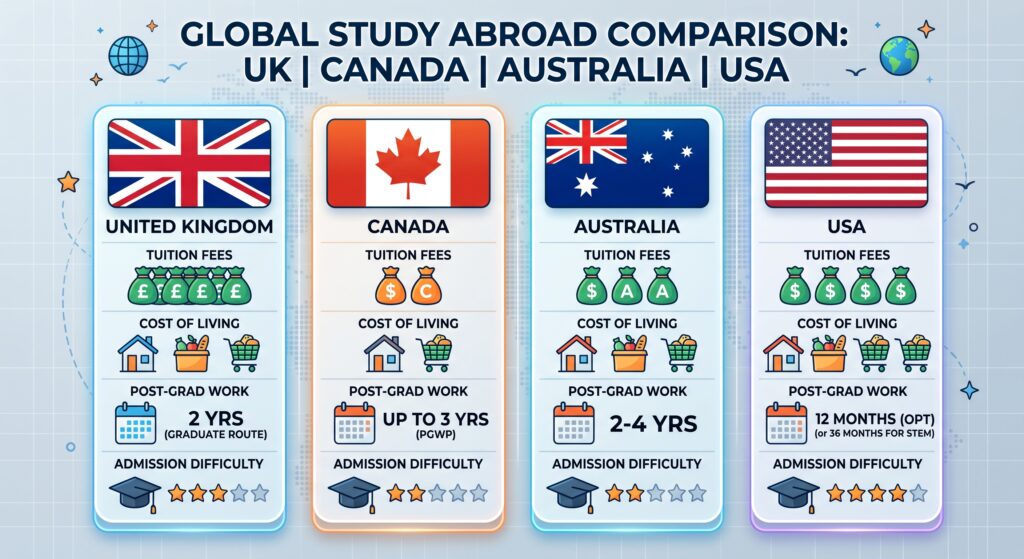
UK vs Canada vs Australia vs USA is the single most common question Indian students ask once they’ve decided to study abroad but haven’t picked a country yet. Each has genuine strengths, and the “best” answer depends heavily on your budget, career goals, and risk tolerance — not a universal ranking. Here’s a straight, side-by-side comparison across the factors that actually matter.
Quick Comparison at a Glance
| Factor | UK | Canada | Australia | USA |
|---|---|---|---|---|
| Typical Master’s duration | 1 year | 1-2 years | 1-2 years | 1.5-2 years |
| Post-study work rights | Up to 2 years (Graduate visa) | Up to 3 years (PGWP) | 2-4 years (subclass 485) | 1-3 years (OPT/STEM OPT) |
| Visa approval rate | Moderate-high | High | High | Moderate |
| Relative cost | High (esp. London) | Moderate | Moderate-high | Wide range |
| PR pathway | Longer, more complex | Relatively clear | Relatively clear | Longer, more complex |
UK vs Canada vs Australia vs USA: Cost of Living & Tuition
The USA has the widest cost range of the four — from moderately priced state universities to very expensive private ones — making it hard to generalize. The UK’s shorter typical program length (often 1 year for a Master’s) can offset its higher annual cost. Canada and Australia sit in a broadly similar moderate-to-high range, with significant variation by city — Toronto and Sydney cost noticeably more than smaller cities in either country. See our full cost comparison guide for country-specific numbers.
Post-Study Work Rights — Often the Deciding Factor
This is where the four countries diverge most, and it’s frequently the single biggest factor in final decisions. Canada’s PGWP can extend up to 3 years depending on program length, and its pathway toward permanent residency is generally considered one of the clearer routes among major destinations. Australia’s subclass 485 now offers 2-4 years depending on your degree level. The UK’s Graduate visa offers a flat 2 years (3 for PhD). The USA’s OPT (1 year, or up to 3 with STEM OPT) is real but has recently faced increased regulatory scrutiny, adding some uncertainty to long-term planning there.
Visa Difficulty & Approval Rates
Canada and Australia generally have more predictable, if occasionally more paperwork-heavy, visa processes, with fairly transparent documentation requirements once you understand them (GIC/SDS for Canada, GS requirement for Australia). The UK’s process is comparatively straightforward given no interview is typically required for most student applicants. The USA’s F-1 process involves a mandatory in-person interview, and the recent shift away from Duration of Status has added new complexity for longer programs — see our USA study guide for the full detail on that change.
Which Country Fits Which Kind of Student
Choose the UK if: you want a shorter program duration to minimize total cost and time, and you’re targeting a field where UK universities have particularly strong global reputation (finance, law, certain sciences).
Choose Canada if: post-study work rights and an eventual PR pathway are your top priorities, and you’re comfortable with the GIC/blocked-funds style financial planning it requires.
Choose Australia if: you want strong post-study work rights with degree-level flexibility (2-4 years) and are targeting fields aligned with Australia’s National Planning Level priorities — though the recent student cap makes competitive programs harder to secure than a couple of years ago.
Choose the USA if: your target field and university genuinely have a strong reputation advantage there, you’re comfortable navigating a more interview-driven visa process, and you’re prepared for a fixed admission period tied to your program length under the new rules. UK vs Canada vs Australia vs USA
What This Comparison Doesn’t Tell You
No comparison table captures your specific academic profile, budget ceiling, risk tolerance, or long-term goals (settling abroad vs returning to India after gaining international experience). Two students with identical grades can have completely different “best” answers depending on what they’re actually optimizing for — cost, speed, career outcome, or immigration pathway. UK vs Canada vs Australia vs USA
Frequently Asked Questions
Which is easier to get a visa for — UK, Canada, Australia, or USA?
Canada and Australia generally have more predictable visa processes for well-documented applications; the USA’s interview-based process and the UK’s financial evidence window both require careful preparation but aren’t inherently “harder,” just different. UK vs Canada vs Australia vs USA
Which country has the best post-study work rights right now?
Canada’s PGWP and Australia’s subclass 485 (degree-dependent) currently offer the longest work windows among the four, though all four have seen policy changes recently, so it’s worth checking current rules against your specific program length. UK vs Canada vs Australia vs USA
Can I compare all four for my specific profile?
Yes — this general comparison is a starting point, but a proper comparison needs to factor in your specific field, budget, and academic profile, which is exactly what a counselling session is for. UK vs Canada vs Australia vs USA
How Goyad Travel Helps
A generic comparison table only goes so far — the right choice depends on your specific profile, budget, and goals. We walk through this exact UK vs Canada vs Australia vs USA decision with every student during initial counselling, matched against your actual numbers rather than general trends. Explore our country-specific guides for UK, Canada, Australia, and USA for the full detail on each. UK vs Canada vs Australia vs USA
Still deciding between countries? Talk to us on WhatsApp or call +91 7997226661 / +91 7997226662.
📍 Goyad Travel — Road No. 11, Reliance Humsafar Building, Banjara Hills, Hyderabad, Telangana | View on Google Maps
📧 contact@goyadtravel.com | 🕐 Monday–Saturday, 9:00 AM – 7:00 PM